
The ocean, like the land, has its own meteorological monitoring stations. However, marine observation systems can do much more than monitor weather. By combining surface-based meteorological instruments with underwater sensors, they provide a three-dimensional view of the marine environment, helping scientists better understand ocean conditions and processes.
Are There Weather Stations at Sea?
When we think of weather stations, we often associate them with weather forecasts. The information broadcast on television and radio comes from meteorological observations collected by stations distributed around the world. Most familiar weather stations are located on land, but similar systems also operate across the oceans.
These facilities are commonly known as marine observation stations or ocean observation stations. They vary considerably in design, size, and deployment location. Some are established on islands or reefs, while others are installed on mobile or fixed vessels, large ocean buoys, or artificial offshore towers.
Many marine observation stations combine above-water meteorological monitoring with underwater environmental observation.
The above-water section is primarily responsible for monitoring marine weather. It can be equipped with multiple meteorological sensors to measure wind speed, wind direction, air temperature, and atmospheric pressure. Some systems also incorporate ocean wave radar, enabling large-scale wave monitoring over an extensive sea area.
The underwater section focuses on marine environmental conditions. Depending on the monitoring objectives, it may carry hydrological, chemical, and ecological sensors to measure waves, currents, tides, seawater temperature, salinity, nutrients, chlorophyll, and other important parameters.
Together, these instruments provide complementary information about the atmosphere, sea surface, and underwater environment, supporting a more comprehensive understanding of ocean dynamics.
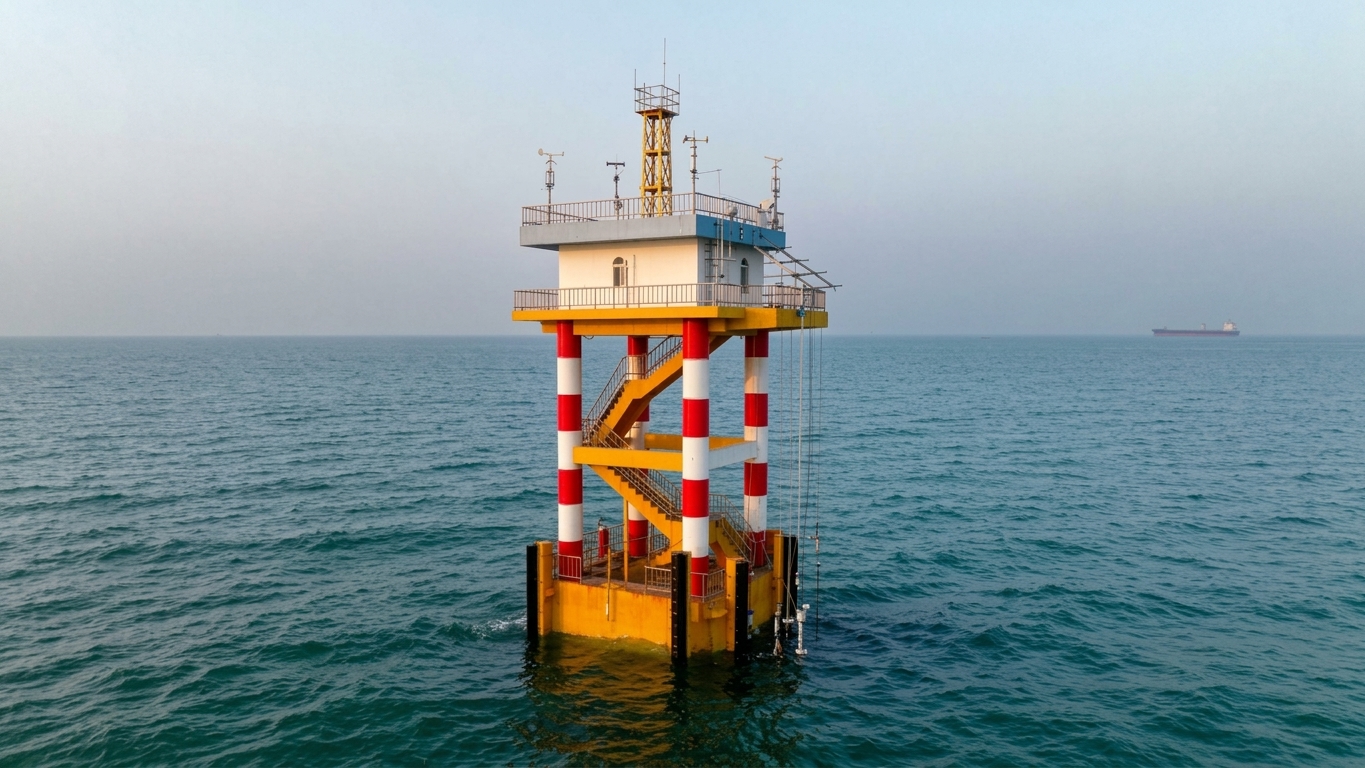
An Offshore Observation Station Built on an Artificial Tower
Consider a marine observation station located in waters approximately 25 meters deep. The entire facility is built on an artificial tower extending from the seabed to above the sea surface.
The tower accommodates a meteorological station, a laboratory, and even a helicopter landing platform. Below the waterline, various marine sensors are installed along the submerged structure to continuously monitor underwater environmental conditions.
This type of integrated facility illustrates how offshore infrastructure can support long-term, multidimensional marine observation, bringing together meteorological monitoring, underwater measurements, and scientific research in a single location.
Why Do We Need Seafloor Observatory Networks?
Traditional oceanographic research has long relied on scientific research vessels. Researchers collect water samples, sediment samples, and other observational data at sea, then return to laboratories to analyze them and investigate ocean phenomena and processes.
Although this approach remains essential to marine science, it has several limitations. Research cruises can be expensive and time-consuming, and their schedules depend on vessel availability, weather, and sea conditions. In addition, ship-based surveys generally provide observations at specific locations and times, making it difficult to capture every change in a complex and constantly evolving ocean environment.
This raises an important question: Can scientific instruments remain on the seafloor for extended periods, continuously collecting data and conducting experiments according to researchers’ needs?
Seafloor observatory networks are designed to help achieve this goal.
What Is a Seafloor Observatory Network?
A seafloor observatory network is an unmanned marine monitoring system designed for long-term observation of the seabed and surrounding ocean environment. Depending on its configuration, it can support real-time data acquisition and transmission, sample collection and analysis, and in-situ experiments.
By keeping instruments deployed underwater for extended periods, these networks help overcome some of the limitations of conventional ship-based surveys. They can provide continuous, real-time, and high-resolution observations of marine environmental conditions and ocean processes, with less dependence on research vessel schedules and short-term weather windows.
This approach enables scientists to observe changes as they occur rather than relying solely on measurements collected during periodic expeditions. It also creates new opportunities to investigate seabed processes, monitor environmental changes, and improve understanding of how the ocean evolves over time.
From Seafloor Instruments to Integrated Observation Networks
In recent years, countries around the world have invested in the research and development of seafloor observatory technologies and equipment. Various observatory systems have entered operation, while larger-scale networks have been developed to support long-term observations across broader marine regions.
These initiatives reflect a growing interest in continuous ocean monitoring and the development of infrastructure capable of collecting valuable scientific data over extended periods.
As marine observation technologies continue to advance, the integration of offshore meteorological stations, underwater sensors, and seafloor observatory networks will play an increasingly important role in oceanographic research and marine environmental monitoring.
Post time: Oct-10-2026