
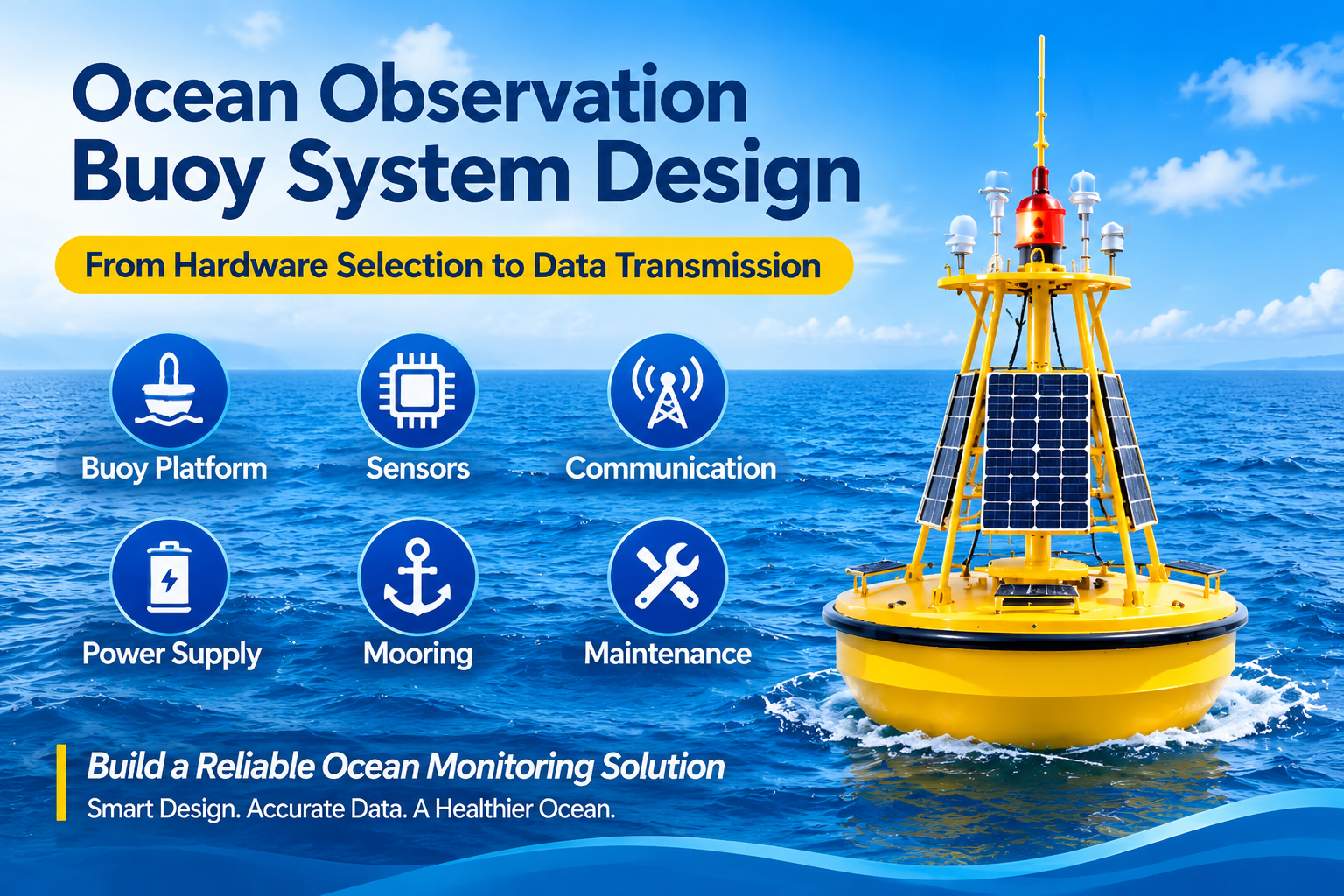
An ocean observation buoy system integrates multiple technologies to collect and transmit real-time marine environmental data. Building a reliable system requires careful consideration of buoy selection, sensor configuration, communication, power supply, and mooring design.
Here are six key factors to consider when designing an ocean monitoring buoy.
1. Choose the Right Buoy Platform
The buoy platform must provide sufficient stability, buoyancy, and space for monitoring instruments. Its size and material should match the deployment environment, considering wave conditions, corrosion resistance, and equipment load.
2. Select Suitable Monitoring Sensors
Sensor configuration depends on project requirements. Common options include:
- Meteorological sensors: Wind speed, wind direction, temperature, humidity, and atmospheric pressure.
- Oceanographic sensors: Water temperature, salinity, depth, and current.
- Water quality sensors: pH, dissolved oxygen, and turbidity.
Compatible interfaces and appropriate power consumption are essential for reliable system integration.
3. Configure Data Communication
Communication methods should match the deployment location. Cellular networks such as 4G/5G are suitable for areas with coverage, while satellite communication supports offshore applications.
A data logger with local storage also helps prevent data loss during temporary communication interruptions.
4. Design an Efficient Power System
Solar panels and rechargeable batteries are commonly used to support long-term autonomous operation. Power capacity should be calculated based on sensor consumption, sampling frequency, sunlight conditions, and backup requirements.
5. Ensure Reliable Mooring
A suitable mooring system keeps the buoy in its designated monitoring area. Design considerations include water depth, waves, currents, wind loads, anchor capacity, and mooring line strength.
The final configuration should be based on actual deployment conditions and engineering calculations.
6. Plan for Long-Term Maintenance
Marine biofouling, corrosion, and changing environmental conditions can affect monitoring performance. Antifouling measures, regular sensor inspection, battery checks, and remote system monitoring help maintain long-term data reliability.
Integrated Ocean Observation Solutions by Frankstar
A reliable ocean observation buoy system requires seamless integration of the buoy platform, sensors, power supply, communication, and data acquisition equipment.
FRANKSTAR provides ocean observation buoys, meteorological instruments, wave sensors, CTD profilers, and water quality monitoring equipment for a wide range of marine applications.
Contact Frankstar Technology to discuss your project requirements and explore a suitable
Post time: Nov-12-2026