
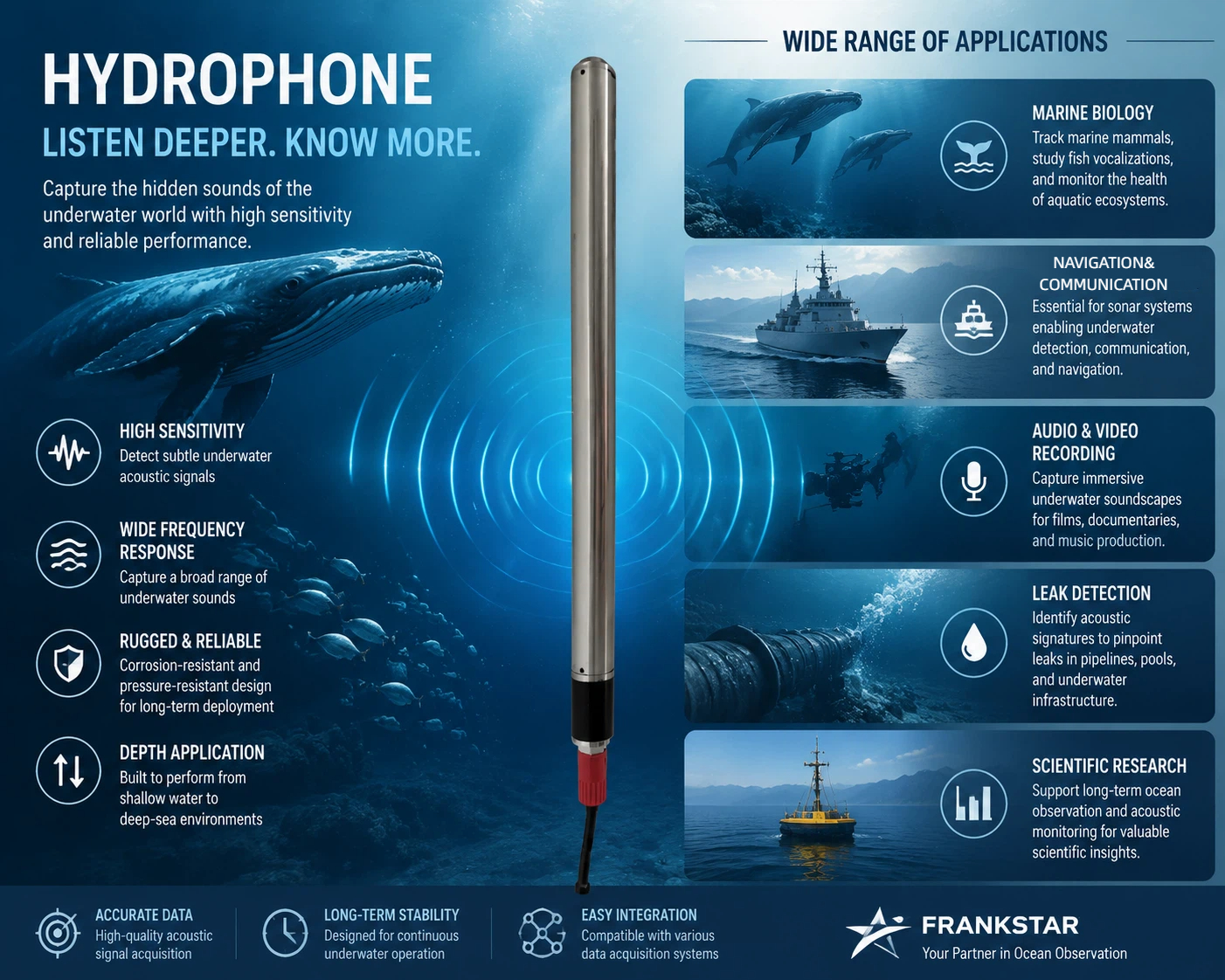
Hydrophone: A Professional Solution for Underwater Acoustic Monitoring and Marine Research
Introduction
The ocean is a complex acoustic environment filled with valuable information. From marine biological activities and underwater communication to oceanographic research and environmental monitoring, underwater sound plays an essential role in understanding and protecting marine ecosystems.
A hydrophone is a specialized underwater acoustic sensor designed to detect, receive, and record sound waves underwater. Similar to a microphone used in the air, a hydrophone converts underwater acoustic signals into electrical signals, allowing researchers and engineers to analyze underwater sound information.
With the increasing demand for marine observation and environmental protection, underwater hydrophones have become important tools in ocean exploration, marine science, underwater monitoring, and acoustic research.
What Is a Hydrophone?
A hydrophone is an underwater sensor that uses a sensitive acoustic transducer to capture sound pressure variations in water. The sensor converts underwater sound waves into electrical signals that can be processed, stored, and analyzed.
Unlike conventional sensors that measure physical parameters such as temperature or pressure, hydrophones focus on underwater acoustic information, including:
- Marine biological sounds
- Underwater noise pollution
- Ship and machinery noise
- Ocean environmental signals
- Acoustic communication signals
Modern hydrophone sensors typically use piezoelectric materials due to their excellent sensitivity, wide frequency response, and stable performance in underwater environments.
How Does a Hydrophone Work?
A hydrophone operates based on the principle of acoustic-to-electrical conversion.
When underwater sound waves reach the hydrophone sensor, the internal acoustic transducer generates electrical signals according to the changes in sound pressure. These signals can then be amplified, recorded, transmitted, and analyzed through an underwater acoustic monitoring system.
A complete hydrophone monitoring system usually includes:
- Hydrophone sensor
- Signal conditioning unit
- Data acquisition system
- Storage or transmission module
- Analysis software platform
This allows users to perform long-term and real-time underwater acoustic observation.
Key Advantages of Hydrophone Sensors
1. High Sensitivity for Underwater Sound Detection
Hydrophones are designed with highly sensitive acoustic transducers to capture weak underwater sounds. This makes them suitable for detecting biological sounds, environmental noise, and subtle acoustic variations.
2. Wide Frequency Response
Professional hydrophones support a wide frequency range, allowing accurate recording of different underwater acoustic signals, from low-frequency ocean noise to high-frequency biological sounds.
3. Reliable Performance in Harsh Marine Environments
Designed for underwater operation, hydrophones typically feature:
- Waterproof construction
- Corrosion-resistant materials
- Stable acoustic performance
- Long-term deployment capability
They can operate reliably in oceans, lakes, rivers, and other aquatic environments.
4. Real-Time Underwater Acoustic Monitoring
Hydrophone systems can be integrated with data acquisition equipment and communication platforms to provide real-time monitoring and remote access to underwater acoustic data.
5. Flexible Applications
Hydrophones can be deployed independently or integrated with marine observation systems, underwater platforms, buoys, and research equipment.
Applications of Hydrophones
Marine Biological Research
Marine organisms produce various sounds during communication, navigation, and feeding activities. Hydrophones help researchers study:
- Whale and dolphin vocalizations
- Fish acoustic behavior
- Marine ecosystem activities
- Biodiversity changes
By analyzing underwater sounds, scientists can better understand marine ecosystems.
Ocean Environmental Monitoring
Underwater noise has become an important indicator of marine environmental conditions. Hydrophones are widely used for:
- Underwater noise measurement
- Marine ecosystem assessment
- Human activity impact analysis
- Long-term ocean observation
They provide valuable acoustic data for marine environmental protection.
Underwater Acoustic Research
Hydrophones are essential tools for oceanographic research, including:
- Acoustic propagation studies
- Ocean soundscape analysis
- Underwater communication research
- Marine science experiments
Research institutions use hydrophones to collect accurate acoustic data for scientific analysis.
Underwater Engineering and Infrastructure Monitoring
Hydrophones can support monitoring of underwater infrastructure, including:
- Offshore platforms
- Submarine cables
- Marine construction projects
- Underwater equipment
Acoustic monitoring helps identify abnormal sounds and improve operational safety.
Underwater Communication and Navigation
Hydrophones are also used in underwater acoustic systems for:
- Signal receiving
- Acoustic communication
- Navigation assistance
- Equipment testing
They provide reliable underwater signal detection capabilities.
Hydrophone Selection Considerations
When selecting a hydrophone sensor, several factors should be considered:
Frequency Range
Different applications require different frequency responses. Marine biology studies may require high sensitivity across specific frequency bands, while engineering monitoring may focus on lower-frequency signals.
Sensitivity
Higher sensitivity allows detection of weaker underwater acoustic signals.
Depth Rating
The hydrophone should be suitable for the intended deployment depth, from shallow water observation to deep-sea applications.
Durability
Marine environments require sensors with strong waterproofing, corrosion resistance, and long-term stability.
Integration Capability
Compatibility with data loggers, acoustic systems, and monitoring platforms is important for complete underwater observation solutions.
Hydrophone Applications in Modern Marine Observation
With the development of smart ocean monitoring technologies, hydrophones are increasingly integrated into comprehensive marine observation systems.
A modern marine monitoring network may combine:
- Hydrophones
- CTD sensors
- Water quality sensors
- Ocean buoys
- Remote telemetry systems
- Data management platforms
Together, these technologies provide a complete solution for understanding marine environments through physical, chemical, and acoustic observations.
Conclusion
A hydrophone is a powerful underwater acoustic sensor that enables researchers and engineers to explore the hidden acoustic world beneath the water surface. From marine biology and environmental monitoring to underwater engineering and scientific research, hydrophones provide essential acoustic data for modern ocean observation.
As the demand for marine protection and ocean exploration continues to grow, reliable underwater hydrophone sensors will play an increasingly important role in building smarter and more sustainable marine monitoring systems.
Post time: Jul-14-2026