
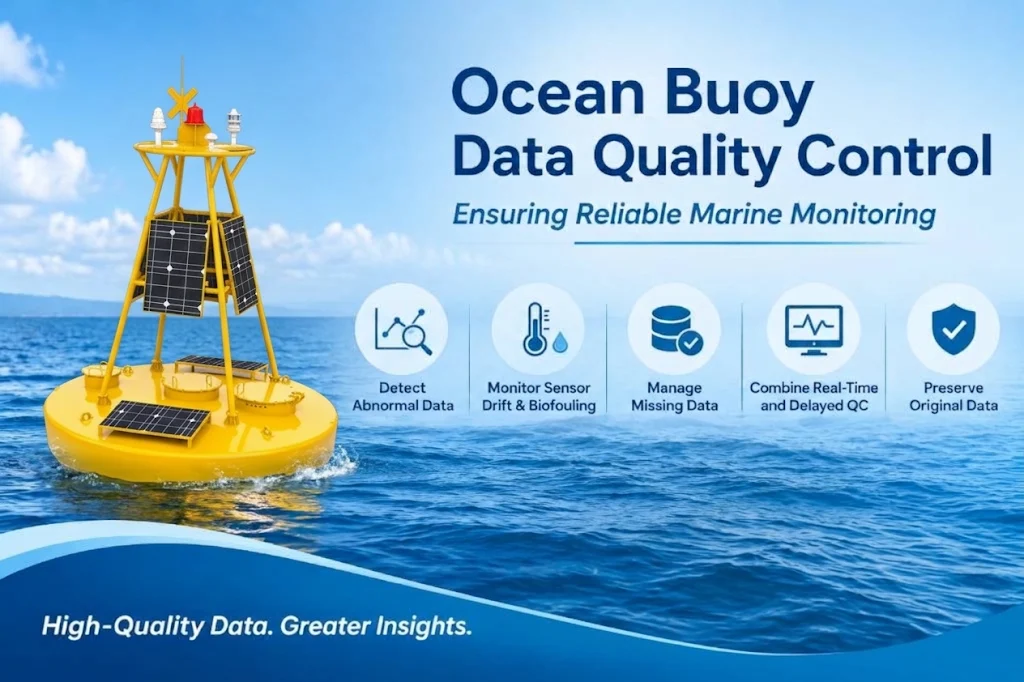
Ocean observation buoys continuously collect data on water temperature, salinity, waves, and currents. However, sensor drift, biofouling, environmental interference, and communication failures can affect measurement accuracy.
Effective ocean buoy data quality control is essential to ensure reliable data for scientific research and marine environmental monitoring.
1. Detect Abnormal Data
Data quality control starts with identifying measurements outside reasonable physical limits. Sudden changes in temperature, salinity, or wave measurements should also be flagged for further investigation.
Instead of automatically deleting suspicious records, quality flags should be assigned to preserve the original data for review.
2. Monitor Sensor Drift and Biofouling
Long-term deployment can affect sensor performance. Calibration drift may gradually reduce measurement accuracy, while marine organisms accumulating on sensor surfaces can interfere with readings.
Regular calibration, equipment inspection, historical data comparison, and reference measurements help identify these problems and maintain data consistency.
3. Manage Missing Data
Power interruptions, communication failures, and instrument malfunctions may cause missing observations.
Data gaps should be clearly identified rather than filled with arbitrary estimates. When interpolation or data reconstruction is necessary, estimated values should be marked separately from actual measurements to maintain data transparency.
4. Combine Real-Time and Delayed Quality Control
A reliable marine data quality control system should include two stages:
- Real-time QC: Automatically screens incoming data for abnormal values, sudden changes, and missing records, allowing operators to identify potential problems quickly.
- Delayed QC: Uses historical trends, calibration records, and expert review to evaluate data consistency and sensor performance.
Combining both methods improves monitoring efficiency and overall data reliability.
5. Preserve Original Monitoring Data
Original measurements should always be retained throughout the quality control process. A well-managed dataset should distinguish between raw measurements, flagged data, corrected values, and estimated observations.
This ensures data traceability and supports reliable scientific analysis.
Reliable Data Starts with Reliable Monitoring Systems
Accurate marine environmental monitoring requires more than high-performance sensors. Reliable data acquisition, stable communication, proper equipment maintenance, and effective quality control are equally important.
FRANKSTAR provides oceanographic instruments and buoy-based monitoring solutions, supporting long-term marine data collection and remote monitoring across different oceanographic applications.
Contact Frankstar to explore suitable solutions for your marine monitoring projects.
Post time: Nov-20-2026