
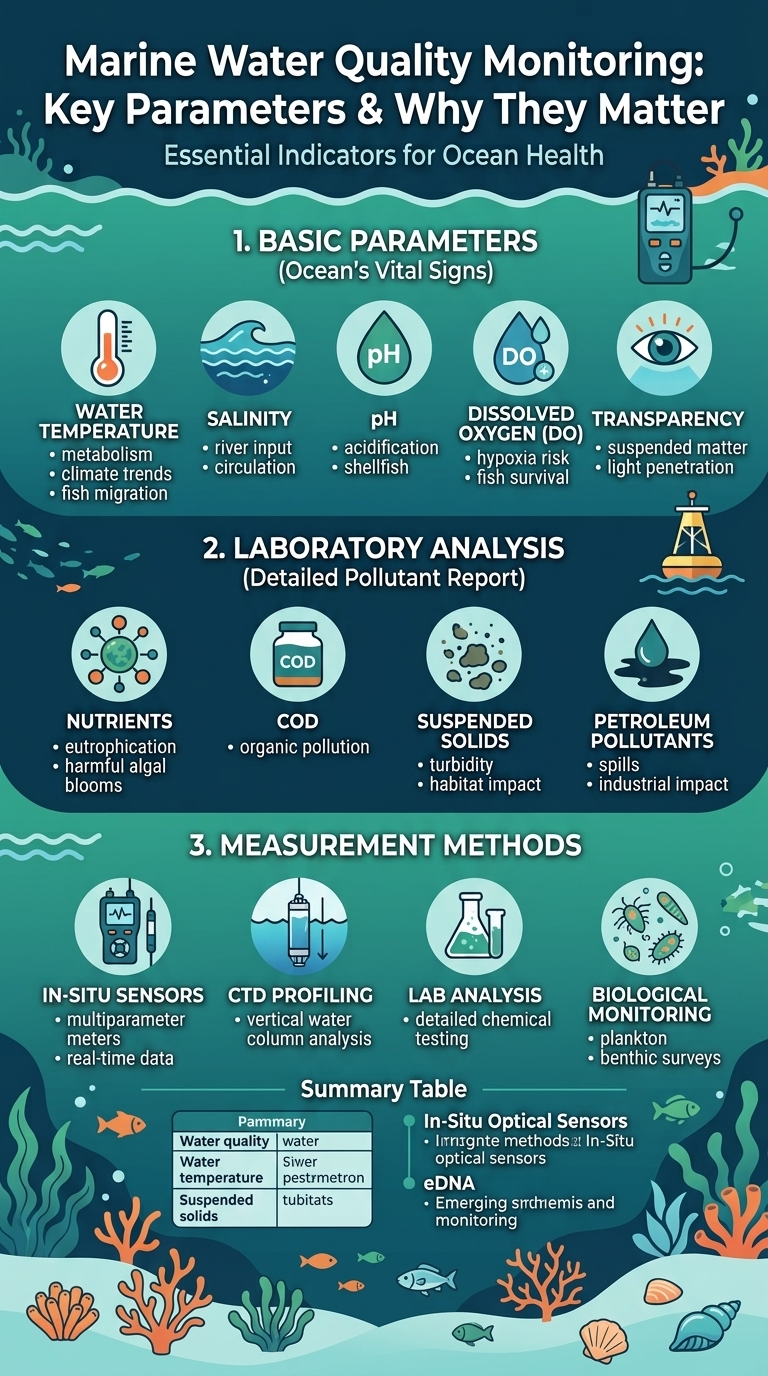
Marine Water Quality Monitoring: What Parameters Do We Measure and Why Do They Matter?
When we talk about water quality compliance, marine ecological assessment, pollution monitoring, and environmental disaster warning, one thing is always essential: reliable marine monitoring data.
But what exactly do scientists and environmental monitoring teams measure when they conduct a “health check” of the ocean?
From basic physical and chemical parameters to laboratory analysis and biological surveys, marine environmental monitoring involves a wide range of measurements. Each parameter provides a different piece of information about the condition of seawater and marine ecosystems.
In this article, we will look at the major categories of marine water quality monitoring parameters, how they are measured, and what they can tell us about the marine environment.
1. Basic Water Quality Parameters: The Ocean’s “Vital Signs”
Just as a medical examination begins with basic vital signs such as body temperature and blood pressure, marine monitoring starts with fundamental water quality parameters.
These measurements provide the basic information needed to understand the physical and chemical condition of seawater.
Water Temperature
Water temperature is one of the most fundamental physical parameters in ocean monitoring.
Temperature affects marine organisms in many ways, including their growth, reproduction, metabolism, and migration. It also influences physical processes such as water circulation and the behavior and transport of pollutants.
Long-term changes in ocean temperature are also an important indicator of changes in the global climate system.
For marine monitoring projects, continuous or periodic temperature measurements can help researchers understand:
- Seasonal changes in seawater conditions
- Marine organism habitats
- Ocean circulation patterns
- Coastal environmental changes
- Long-term climate trends
Salinity
Salinity describes the concentration of dissolved salts in seawater and is one of the defining characteristics of the marine environment.
Salinity can vary significantly between different marine areas. For example, coastal waters near river estuaries may have lower salinity because of freshwater input, while open-ocean areas generally have more stable salinity conditions.
Monitoring salinity can help researchers study:
- Freshwater and river discharge
- Ocean circulation
- Water-mass distribution
- Coastal mixing processes
- Changes in marine habitats
When combined with temperature and depth measurements, salinity data becomes particularly useful for understanding oceanographic water masses and circulation.
pH
pH measures the acidity or alkalinity of seawater and is an important parameter in marine environmental monitoring.
The ocean absorbs a significant amount of atmospheric carbon dioxide. Changes in seawater chemistry associated with increasing CO₂ concentrations can reduce ocean pH over time, a process commonly referred to as ocean acidification.
Changes in pH can affect marine organisms, particularly calcifying organisms such as corals and shellfish.
Therefore, long-term pH monitoring can provide valuable information for:
- Ocean acidification research
- Marine ecosystem assessment
- Coastal environmental monitoring
- Aquaculture management
- Marine biodiversity studies
Dissolved Oxygen
Dissolved oxygen (DO) refers to the amount of oxygen dissolved in water.
It is essential for fish, shellfish, microorganisms, and other aquatic organisms. At the same time, dissolved oxygen is an important indicator of the condition of a water body.
When excessive organic matter enters water, microorganisms may consume oxygen while decomposing it. This can result in declining dissolved oxygen concentrations.
If oxygen levels become sufficiently low, aquatic organisms may experience significant stress, and severe oxygen depletion can create hypoxic conditions.
For this reason, DO monitoring is widely used in:
- Coastal water quality assessment
- Aquaculture
- Pollution monitoring
- Estuary monitoring
- Marine ecosystem studies
Transparency and Water Color
Water transparency describes how clearly light can penetrate seawater, while water color provides a visual indication of the optical characteristics of the water.
Changes in transparency and water color can be associated with variations in suspended particles, phytoplankton, organic matter, and other substances in the water.
These parameters can therefore provide a rapid preliminary indication of changes in water conditions and can support the assessment of:
- Suspended matter
- Phytoplankton abundance
- Water turbidity
- Coastal pollution
- Eutrophication
2. Laboratory Analysis Parameters: The Ocean’s “Test Report”
While field measurements provide immediate information about basic water conditions, laboratory analysis can provide more detailed information about specific pollutants and chemical substances.
Common laboratory analysis parameters include nutrients, chemical oxygen demand, suspended solids, and petroleum-related pollutants.
Nutrients
Nutrients such as:
- Ammonia nitrogen
- Nitrate nitrogen
- Nitrite nitrogen
- Reactive phosphate
are essential for the growth of aquatic plants and microorganisms.
However, excessive nutrient inputs from rivers, domestic wastewater, agriculture, and industrial activities can contribute to eutrophication.
High nutrient concentrations can stimulate excessive phytoplankton or algae growth. Under certain environmental conditions, this may contribute to ecological events such as harmful algal blooms.
Therefore, nutrient monitoring is an important part of:
- Coastal water quality assessment
- Eutrophication monitoring
- Harmful algal bloom research
- Estuary monitoring
- Marine pollution assessment
Chemical Oxygen Demand
Chemical Oxygen Demand (COD) is a commonly used water quality parameter associated with the amount of oxidizable substances present in water.
Elevated COD values can indicate increased levels of organic or other oxidizable pollutants and may be associated with wastewater and other pollution sources.
COD monitoring can therefore support environmental authorities and researchers in evaluating changes in water quality and identifying areas that require further investigation.
Suspended Solids
Suspended solids are particles suspended in the water column.
Excessive suspended solids can reduce light penetration, potentially affecting submerged vegetation and other photosynthetic organisms.
Suspended particles can also interact with contaminants and eventually settle onto the seabed, potentially affecting benthic habitats.
Monitoring suspended solids is particularly relevant to:
- Coastal construction
- Dredging projects
- Port development
- River-sea interfaces
- Sediment transport studies
- Marine environmental impact assessment
Petroleum Pollutants
Petroleum hydrocarbons are another important category of marine pollutants.
Potential sources include shipping activities, ports, offshore oil and gas operations, and accidental spills.
Petroleum contamination can affect marine organisms and may persist in sediments and coastal environments depending on the type of petroleum product and environmental conditions.
Monitoring petroleum-related pollutants is therefore an important component of environmental management in areas with significant maritime and offshore activities.
3. How Are Marine Water Quality Parameters Measured?
A common question is: How do scientists actually measure all these parameters?
In practice, marine monitoring uses a combination of in-situ measurement, water sampling, laboratory analysis, and biological investigation.
The specific methods depend on the parameter, monitoring objectives, environmental conditions, and applicable monitoring standards.
In-Situ Measurement
Some basic water quality parameters can be measured directly in the field.
Parameters such as:
- Water temperature
- Salinity
- pH
- Dissolved oxygen
can be measured using portable multiparameter water quality meters or CTD profiling systems.
The instruments are deployed directly into the water, allowing monitoring teams to obtain measurements at specific locations and depths.
This approach is particularly useful when researchers need to understand how water quality changes vertically through the water column.
CTD Profiling
A CTD system typically measures:
Conductivity → Temperature → Depth
From conductivity and temperature measurements, seawater properties such as salinity can be derived.
Additional sensors can also be integrated into a CTD platform to measure parameters such as:
- Dissolved oxygen
- pH
- Turbidity
- Chlorophyll
- Other water quality parameters
This makes CTD systems an important tool for oceanographic surveys.
4. Laboratory Analysis of Seawater Samples
Not every parameter can be measured directly in the field.
For many chemical parameters, seawater samples are collected according to applicable monitoring procedures and then transported to a laboratory for analysis.
Depending on the parameter, laboratory instruments may include:
- Continuous flow analyzers
- Spectrophotometers
- Nutrient analyzers
- Other analytical instruments
For example, nutrient parameters such as nitrite nitrogen can be analyzed using appropriate laboratory analytical systems, while petroleum-related pollutants may be analyzed using spectrophotometric or other standardized analytical methods.
Laboratory analysis generally provides more detailed chemical information than simple field screening.
5. Biological Monitoring: Looking Beyond Water Chemistry
Marine environmental assessment is not limited to water chemistry.
The condition of marine ecosystems also depends on the organisms living in the water column and on the seabed.
Biological monitoring may include surveys of:
- Phytoplankton
- Zooplankton
- Fish eggs
- Fish larvae and juveniles
- Benthic organisms
Plankton Sampling
Phytoplankton and zooplankton can be collected using specialized plankton nets.
After collection and preservation, samples are transported to the laboratory, where specialists identify organisms and estimate their abundance using microscopes or other laboratory equipment.
These results can provide information about:
- Species composition
- Abundance
- Community structure
- Ecological changes
- Potential eutrophication impacts
Benthic Organism Sampling
Benthic organisms live on or within seabed sediments.
Monitoring teams may use grab samplers to collect sediment samples containing benthic organisms.
The samples are then processed and examined in the laboratory to identify species and determine abundance.
Benthic communities can provide useful information about long-term environmental conditions because changes in sediment quality and pollution can influence the organisms living on the seabed.
6. From Individual Parameters to a Complete Marine Monitoring System
A single parameter rarely provides a complete picture of marine environmental conditions.
For example:
Temperature + Salinity + Depth
can help describe water masses and physical oceanographic conditions.
pH + Dissolved Oxygen + Nutrients
can provide information about chemical and biological processes.
Turbidity + Suspended Solids + Nutrients
can support investigations into coastal pollution and eutrophication.
Water Quality + Plankton + Benthic Organisms
can provide a broader perspective for marine ecosystem assessment.
This is why modern marine environmental monitoring increasingly combines multiple sensors, sampling equipment, data acquisition systems, and communication technologies into integrated monitoring platforms.
7. Technologies for Modern Marine Water Quality Monitoring
For long-term or large-scale monitoring projects, monitoring instruments can be deployed on different platforms according to the project requirements.
These may include:
- CTD systems for water-column profiling
- Multiparameter water quality sensors for in-situ measurements
- Oceanographic buoys for long-term fixed-point monitoring
- Drifting buoys for observing ocean conditions while following water movement
- USVs for mobile water-quality surveys
- ADCPs for current profiling
- Water samplers for laboratory analysis
An integrated monitoring system can combine multiple sensors and platforms to collect data from different dimensions of the marine environment.
Conclusion
Marine environmental monitoring is much more than simply measuring whether seawater is “clean” or “polluted.”
From temperature, salinity, pH, and dissolved oxygen to nutrients, COD, suspended solids, petroleum pollutants, and biological indicators, each parameter provides a different perspective on marine environmental conditions.
Field instruments provide rapid in-situ measurements, laboratory analysis provides detailed chemical information, while biological monitoring helps reveal changes in marine ecosystems.
By combining these different monitoring methods and technologies, researchers and environmental professionals can build a more comprehensive understanding of ocean conditions and support marine pollution monitoring, ecological assessment, environmental management, and long-term ocean observation.
FrankStar provides marine and environmental monitoring equipment, including water-quality sensors, CTD systems, ADCPs, oceanographic buoys, drifting observation buoys, and integrated monitoring solutions, helping users collect reliable data for a wide range of marine and environmental applications.
Looking for a marine water quality monitoring solution for your project? Contact FrankStar to discuss your monitoring requirements.
Post time: Sep-20-2026