
Understanding Ocean Observation Buoys
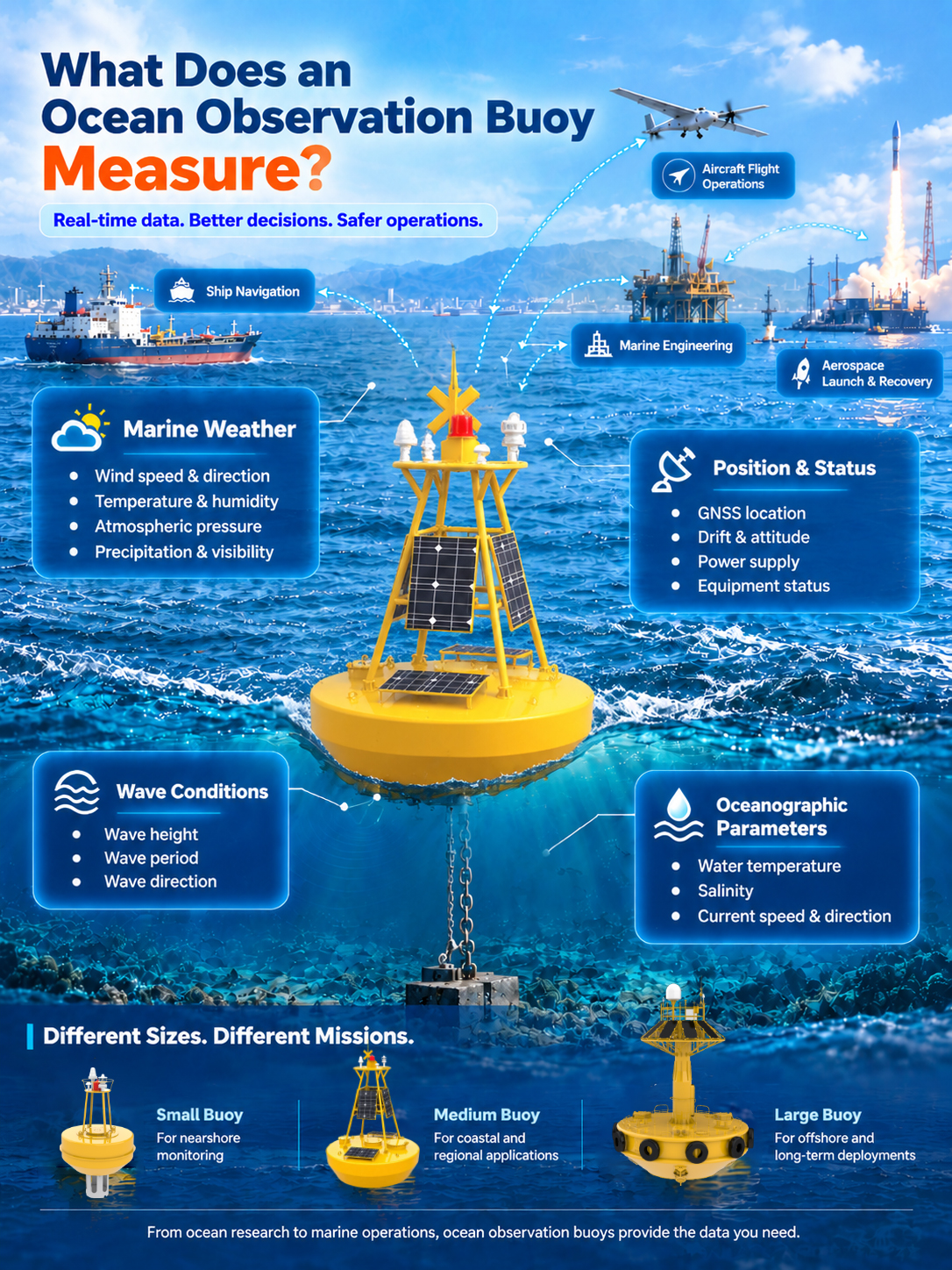
An ocean observation buoy is more than a floating platform. Equipped with specialized sensors and communication systems, it serves as an in-situ data collection point for monitoring changing marine conditions.
From oceanographic research and vessel navigation to offshore engineering and marine operations, ocean observation buoys provide valuable environmental data to support planning, operational safety, and decision-making.
What Does an Ocean Observation Buoy Measure?
Depending on its configuration and deployment requirements, an ocean observation buoy can monitor several categories of environmental data.
1. Marine Weather Conditions
Meteorological sensors can measure wind speed, wind direction, air temperature, humidity, atmospheric pressure, and other weather parameters. These measurements help users understand local marine weather conditions and assess environmental changes.
2. Wave Conditions
Wave monitoring instruments measure parameters such as significant wave height, wave period, and wave direction. These data are useful for evaluating sea states and supporting offshore construction, vessel operations, and marine equipment deployment.
3. Oceanographic Parameters
Ocean observation buoys can be equipped with sensors for water temperature, salinity, current speed, and current direction. These measurements support oceanographic research, marine environmental monitoring, and the assessment of local hydrodynamic conditions.
4. Position and System Status
GNSS positioning and system monitoring can help operators track buoy location, identify potential drift, and check power supply and equipment status. These functions are especially useful for long-term deployments and remote marine monitoring.
How Does an Ocean Observation Buoy Transmit Data?
A typical monitoring workflow includes five steps:
Environmental sensing → Data processing → Communication → Platform analysis → Operational use
Depending on the deployment area and communication requirements, a buoy may use cellular networks, satellite communication, radio links, or dedicated marine communication systems to transmit collected data.
The appropriate communication method depends on factors such as distance from shore, network coverage, power availability, and data transmission frequency.
Applications of Ocean Observation Buoys
Ocean observation buoy data can support a wide range of marine activities:
- Oceanographic research: Collect environmental data for scientific studies and long-term observations.
- Vessel navigation: Provide local information about waves, currents, and weather conditions.
- Offshore engineering: Help project teams assess sea conditions when planning construction and maintenance.
- Marine operations: Support environmental assessment for offshore deployment, recovery, and other operations.
- Environmental monitoring: Track changes in marine conditions over time.
For specialized operations, including offshore launch and recovery support, buoy data can provide useful information about conditions in the target sea area. However, the parameters required depend on the specific mission and monitoring system.
Choosing the Right Ocean Observation Buoy
Ocean observation buoys vary in size, sensor configuration, power supply, communication capabilities, and mooring design. A compact nearshore buoy may be suitable for localized monitoring, while a larger offshore platform may accommodate more instruments and support longer deployments.
When selecting a buoy system, users should consider the required monitoring parameters, deployment depth and location, operating duration, data transmission method, and environmental conditions.
Explore Frankstar Ocean Monitoring Solutions
Frankstar Technology provides ocean monitoring instruments and buoy-based solutions for marine research and environmental observation. Depending on project requirements, suitable systems can integrate sensors for meteorological, wave, current, and other oceanographic measurements.
Looking for an ocean observation buoy for your next project? Contact our team to discuss your monitoring requirements and explore a suitable solution.
Post time: Oct-29-2026