
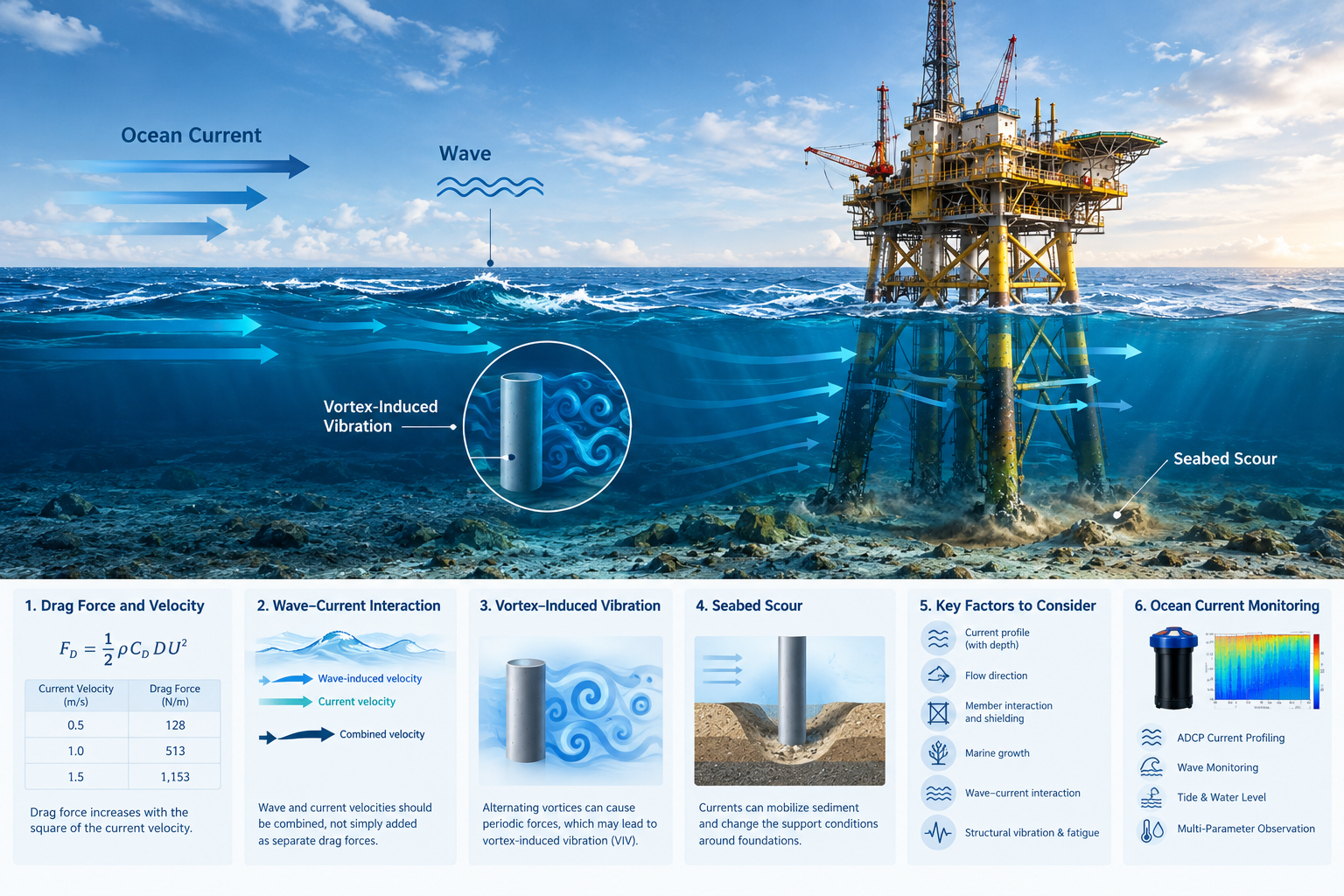
Ocean currents may look slow, but their effects on offshore structures should never be underestimated. Beyond generating hydrodynamic loads, currents interact with waves, contribute to structural vibration, and influence seabed conditions around offshore foundations.
Understanding these effects is essential for offshore engineering and marine environmental monitoring.
1. How Current Velocity Affects Structural Loads
Seawater has a typical engineering density of approximately 1,025 kg/m³. Its high density means that even moderate currents can exert significant forces on submerged structures.
For a slender circular cylinder, the drag force per unit length can be estimated using the drag component of the Morison equation:
F_D = ½ρC_DDU²
Here, ρ represents fluid density, C_D is the drag coefficient, D is the cylinder diameter, and U is the relative flow velocity perpendicular to the cylinder axis.
The key principle is that drag force increases with the square of velocity, assuming other parameters remain constant.
For example, increasing current velocity from 0.5 m/s to 1.5 m/s can increase the calculated drag force ninefold under the same assumptions. This illustrates why small changes in current velocity may significantly affect offshore structural loading.
2. Why Wave-Current Interaction Matters
Ocean currents are not constant background forces. Tidal currents change speed and direction, while wave-induced water motion can combine with the current to increase instantaneous flow velocity.
Because drag depends on velocity squared, wave and current effects cannot always be calculated independently and simply added together.
Engineers must consider the combined flow velocity, wave direction, current profile, and structural geometry when assessing hydrodynamic loads.
3. How Currents Can Cause Structural Vibration
When water flows around cylindrical members, alternating vortices may form and detach, generating fluctuating forces. Under suitable conditions, these forces can cause vortex-induced vibration (VIV).
If vortex shedding interacts with a structure’s natural frequency, vibration may become more significant and contribute to fatigue damage.
Therefore, current loading involves more than mean drag force. Its potential to generate fluctuating loads and structural vibration should also be considered.
4. The Impact of Currents on Seabed Conditions
Ocean currents can also influence the seabed around offshore foundations. When local flow conditions are strong enough to mobilize and transport sediment, scour may develop around piles or other structural supports.
Scour can reduce soil support, increase the exposed length of foundations, and alter structural stiffness and dynamic response.
Its development depends on current velocity, wave-current interaction, sediment properties, and foundation geometry. A current does not automatically cause scour, but the possibility should be evaluated under relevant site conditions.
5. Why Ocean Current Monitoring Is Important
Reliable current measurements help engineers understand marine conditions and support offshore structural assessments.
An Acoustic Doppler Current Profiler (ADCP) measures water velocity at multiple depths, providing valuable information about current speed, direction, and vertical distribution.
Combined with wave, tide, and other environmental measurements, current profiling can support hydrodynamic analysis, marine environmental monitoring, and offshore infrastructure planning.
The appropriate monitoring solution depends on deployment depth, measurement requirements, sampling strategy, and project objectives.
Conclusion
Ocean currents may appear slow, but their effects can extend far beyond direct hydrodynamic loading. Wave-current interaction, vortex-induced vibration, and seabed scour can all influence offshore structural performance.
A current may look slow, but whether it can be neglected is an engineering decision.
Frankstar provides oceanographic and environmental monitoring solutions to support marine observation and data collection. Explore our ADCP current profiling, wave monitoring, tide measurement, and integrated ocean observation solutions to find the right approach for your project.
Post time: Oct-15-2026