
1. Building an Intelligent Ocean Monitoring Network for Real-Time Marine Environmental Data
As pressure on marine ecosystems intensifies and offshore industrial activities expand, the demand for reliable, real-time marine environmental data has never been greater. Traditional methods of periodic manual sampling and delayed laboratory analysis are increasingly unable to meet the requirements of modern ocean observation. In their place, intelligent ocean monitoring networks are emerging as a foundational approach for continuous, synchronized data collection across large water bodies. At the heart of these networks are advanced sensing instruments capable of delivering accurate, actionable information directly from the field. Frankstar’s contribution to this evolution is practical and focused: providing robust, multi-parameter water quality sensors that serve as essential nodes within an integrated monitoring architecture.
2.The Shift Toward Networked Marine Observation
An intelligent ocean monitoring network is not a single product, but a system concept. It brings together in-situ sensors, data loggers, communication modules, and shore-side platforms to create a persistent digital picture of water conditions. This model moves beyond isolated spot measurements, enabling spatial and temporal analysis that supports early warning systems, long-term environmental baseline studies, and compliance reporting for offshore operators.
Building such a network begins with selecting field instruments that can operate reliably in harsh marine environments while delivering standardized data streams that integrate easily into larger infrastructures. The value of the network depends directly on the quality, consistency, and accessibility of the data generated at each sensing point.
3. Frankstar’s Multi-Parameter Water Quality Sensor: A Core Building Block
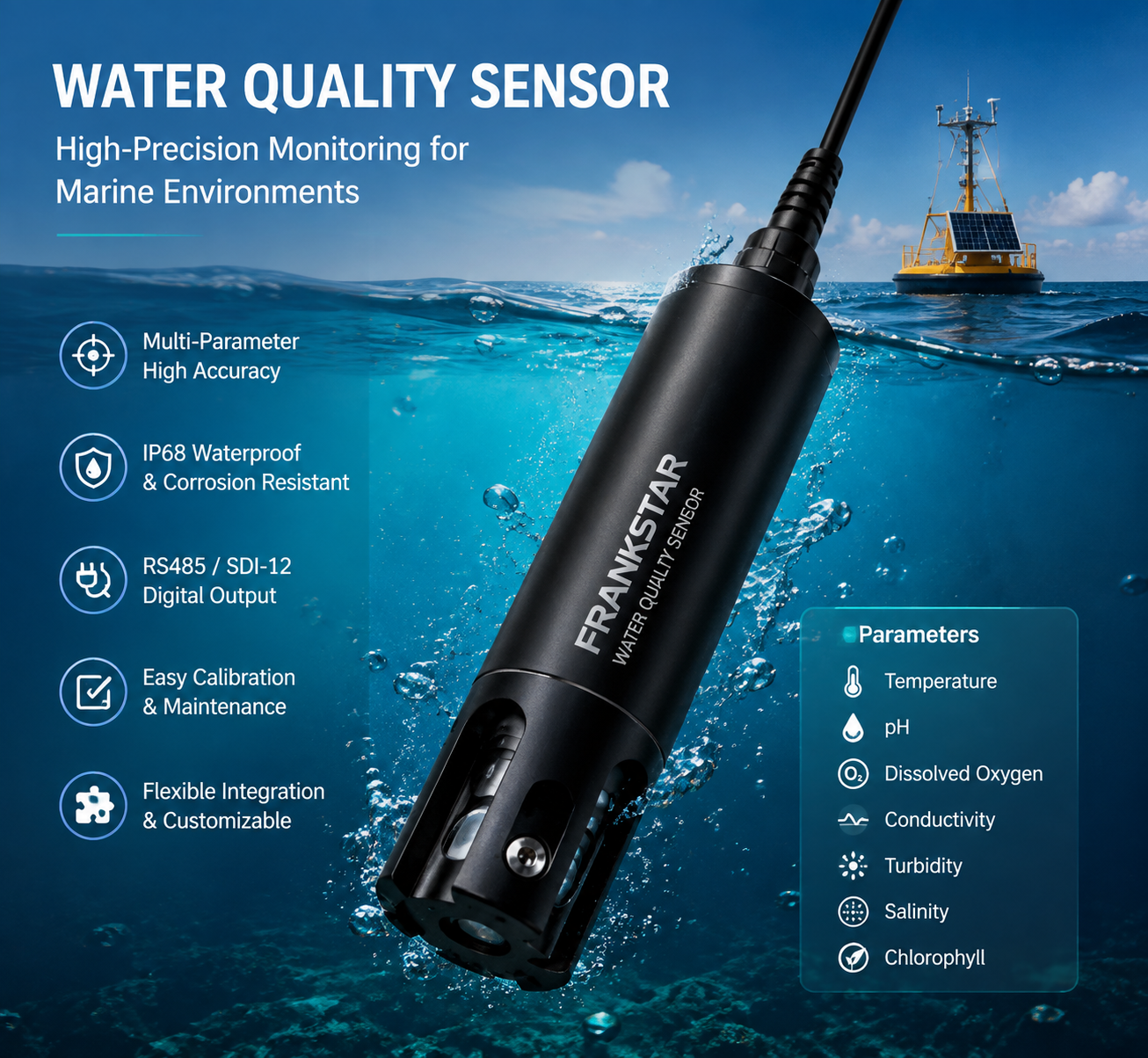
Frankstar offers the FS-DCSZ-001 multi-parameter water quality sensor, a monitoring instrument specifically designed for water quality data acquisition. The sensor integrates multiple sensing elements into one unified probe, enabling simultaneous measurement of key water parameters without requiring separate, disconnected devices at each monitoring station.
Each integrated sensor within the multi-probe system operates according to its parameter-specific detection principle. The instrument employs electrochemical methods for certain parameters, optical techniques for others, and physical detection where appropriate. This hybrid measurement approach helps maintain accuracy across varied water conditions and parameter types. By housing these complementary sensors in a single deployment-ready assembly, the FS-DCSZ-001 reduces installation complexity and potential points of failure within a monitoring network.
Critically, the system outputs data directly in Modbus format. This widely adopted industrial communication protocol makes the sensor immediately compatible with a broad range of data loggers, programmable logic controllers, and telemetry units commonly used in environmental monitoring networks. For operators building or expanding an intelligent ocean monitoring network, this means shorter integration time and reduced need for custom protocol converters.
4.The Role of Real-Time Data in Ocean Monitoring Networks
Real-time marine environmental data is the output that gives an intelligent ocean monitoring network its operational value. When sensors transmit water quality parameters continuously to a central data platform, stakeholders gain the ability to detect changes as they develop. This capability is essential for several scenarios. In aquaculture, sudden shifts in dissolved oxygen or pH can trigger immediate management responses. Near coastal industrial outfalls, real-time turbidity or conductivity readings help operators maintain compliance with discharge permits. For research teams studying ocean acidification or nutrient dynamics, continuous time-series data reveals trends that periodic sampling would miss.
The FS-DCSZ-001 supports this real-time model through its direct Modbus output, which allows seamless data handoff from the sensor to transmission systems without intermediate processing steps that could introduce latency or errors. Within a well-designed network, the data flows from multiple sensor nodes to a single access point, giving users a synchronized, multi-location view of water conditions.
5.Application Scenarios for Intelligent Monitoring Networks
The relevance of intelligent ocean monitoring networks spans scientific, commercial, and regulatory domains. Below are key application areas where sensor nodes like the FS-DCSZ-001 provide fundamental value.
6.Coastal Water Quality Management
Coastal zones face combined pressures from urban runoff, agricultural inputs, and industrial activities. Deploying a network of multi-parameter sensors along a coastline or within an estuary provides continuous insight into parameters that reflect ecosystem stress. The data supports environmental agencies and municipalities in issuing timely public health advisories and designing targeted mitigation measures.
7.Offshore Engineering and Industrial Operations
For offshore wind farms, oil and gas platforms, or port construction projects, environmental monitoring is often a condition of operational permits. An intelligent network that collects real-time data can serve as both a compliance tool and an operational safety asset. Changes in water quality near infrastructure may indicate equipment leaks, sediment resuspension, or other anomalies requiring immediate attention.
8.Marine Research and Climate Studies
Long-term ocean observation programs depend on consistent, comparable datasets collected over years or decades. Integrating the FS-DCSZ-001 into fixed monitoring stations or buoy-based systems helps research institutions build the data archives necessary to understand basin-scale processes. Standardized Modbus output facilitates data sharing across platforms and institutions, an increasingly important consideration in collaborative international research.
9.Aquaculture and Mariculture
Modern fish farms and shellfish operations rely on continuous monitoring to maintain optimal growing conditions and reduce mortality risk. A networked sensor approach gives farm managers a real-time profile of water quality across multiple pens or cultivation areas. Because the sensor integrates several parameters into one housing, it simplifies the equipment footprint at each monitoring point.
10.Designing for Reliability and Integration
An intelligent ocean monitoring network is only as dependable as its individual sensor nodes. Biofouling, corrosion, and physical stress from currents or wave action can degrade instrument performance and data quality over time. While Frankstar’s published product information on the FS-DCSZ-001 emphasizes its multi-parameter measurement capability and Modbus output, the company’s broader expertise in ocean observation technology informs the engineering choices that make the sensor suitable for sustained field deployments.
The sensor’s multi-probe configuration means that users can collect a representative suite of water quality parameters from a single access point in the water column. This simplifies both initial deployment and ongoing maintenance compared to managing separate single-parameter instruments at each location. For network operators, simpler maintenance translates into higher data continuity and lower total cost of ownership over the monitoring network’s lifespan.
11.Looking Ahead: Expanding Network Capabilities
The concept of an intelligent ocean monitoring network continues to evolve alongside advances in data transmission, edge computing, and cloud-based analytics. Future networks will likely incorporate machine learning for automated quality control and anomaly detection, as well as greater interoperability among instruments from different manufacturers. In this landscape, sensors that communicate via open, widely accepted protocols like Modbus are well-positioned to serve as enduring infrastructure components.
Frankstar remains focused on providing reliable ocean observation and marine environmental monitoring products that meet the practical needs of today’s users while aligning with the trajectory of connected monitoring systems. The FS-DCSZ-001 multi-parameter water quality sensor exemplifies this approach by delivering essential in-situ data in a format that supports immediate use and long-term network growth.
12.Conclusion
Real-time marine environmental data is no longer a luxury reserved for flagship research projects; it is an operational necessity across a growing range of marine activities. Building an intelligent ocean monitoring network requires careful instrument selection to ensure accurate measurement, robust field performance, and straightforward data integration. The FS-DCSZ-001 multi-parameter water quality sensor from Frankstar addresses these requirements by combining multiple sensing principles in one instrument and outputting data in the industry-standard Modbus protocol. For international buyers, technical teams, and environmental managers evaluating components for their monitoring networks, the sensor provides a practical, integration-ready foundation for collecting the continuous water quality data that drives informed decision-making in the marine environment.
For more information about the FS-DCSZ-001 multi-parameter water quality sensor and its role in ocean observation networks, visit the official product page at [Frankstar Water Quality Sensor].
Post time: Aug-03-2026