Drifting Profiling Data Buoy for Real-Time Ocean Monitoring

Drifting Profiling Data Buoy for Real-Time Ocean Monitoring,
,
Sensors to assemble/ Element to monitor
| Oceanographic Data | Environmental Data | Additional Parameters |
| Currents | Water temperature | Acoustic profile |
| Salinity | Underwater noise | |
| Hydrocarbon | ||
| Note | ||
| More sensors can be added on Drifting Profiling Data Buoy (FS-DPDB) based on actual needs | ||
Technical Specifications
| Drifting Profiling Data Buoy | ||
| Physical Specification | Model No. | FS-DPDB |
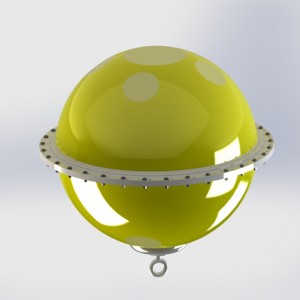
| Dimension | Φ936 mm (Hemisphere: 800 mm) | |
| H: 724 mm | ||
| Weight | 68kg | |
| Materials | Hull: Polyethylene (PE) | |
| Colour | Default orange, customizable | |
| Power Supply Range |
Batteries | Lithium battery pack |
| Battery capacity | 340 Ah | |
| Data Management | Data acquisition | Default 60 min, customizable |
| Battery life | 12 months | |
| Communication | Satellite | |
| Storage | Local SD card, 32G |
Drifting Profiling Data Buoy for Real-Time Ocean Monitoring
Introduction
The ocean is a highly dynamic environment where currents, waves, temperature, atmospheric pressure, and other oceanographic conditions can change continuously across both space and time. Traditional fixed monitoring stations can provide detailed observations at specific locations, but they may have limited ability to capture changing ocean conditions over large areas.
A Drifting Profiling Data Buoy provides a flexible approach to ocean observation by moving with ocean currents while continuously collecting environmental data.
Frankstar’s drifting data buoy is designed for autonomous marine observation, oceanographic research, real-time data collection, and environmental monitoring. By combining drifting observation, profiling capabilities, GNSS-based wave measurement, onboard data storage, and satellite communication, the system can provide valuable information from changing marine environments.
What Is a Drifting Profiling Data Buoy?
A Drifting Profiling Data Buoy is an autonomous ocean observation platform designed to collect environmental data while moving with ocean currents.
Unlike a traditional moored buoy that remains at a fixed geographic position, a drifting buoy follows the movement of the surrounding water. This allows it to observe changing marine conditions along its trajectory.
Depending on the sensor configuration, a drifting profiling buoy can collect parameters such as:
Water temperature
Current velocity
Wave parameters
Sea-level atmospheric pressure
Other oceanographic parameters
The resulting data can be used to analyze ocean circulation, wave conditions, water properties, and environmental changes over a wider geographic area.
Key Features of Frankstar Drifting Profiling Data Buoy
1. Autonomous Drifting Observation
The buoy is designed to drift with ocean currents, allowing it to collect environmental data along its trajectory.
This provides researchers with observations from multiple geographic locations instead of restricting measurements to a single fixed point.
Potential applications include:
Ocean circulation studies
Current observation
Marine environmental monitoring
Large-area ocean surveys
2. Profiling Oceanographic Measurements
The profiling capability allows the system to collect measurements at different positions within the water column according to the configured observation method.
This can provide more information than a simple surface observation platform.
Profiling measurements can support research into:
Water temperature distribution
Current characteristics
Vertical changes in ocean conditions
Water-column dynamics
3. GNSS-Based Wave Observation
The system can incorporate a GNSS wave measurement module to obtain wave-related information while the buoy is drifting.
Wave parameters may include:
Wave height
Wave period
Other wave characteristics depending on system configuration
Combining wave observations with other oceanographic measurements provides a more comprehensive picture of marine conditions.
4. Real-Time Satellite Data Transmission
For drifting platforms operating far from shore, reliable communication is essential.
Frankstar’s drifting data buoy supports Iridium satellite communication, allowing observation data to be transmitted from remote marine environments.
This enables researchers and monitoring organizations to receive data without physically recovering the buoy after deployment.
Real-time transmission can support:
Remote monitoring
Oceanographic research
Data visualization
Marine environmental assessment
Near-real-time observation
5. Large-Capacity Battery System
Long-duration autonomous operation requires an appropriate power system.
The drifting buoy incorporates a large-capacity battery system designed to support long-term marine observation and communication requirements.
Power-system design is particularly important for drifting platforms operating far from research vessels or coastal infrastructure.
6. 32 GB Local Data Storage
In addition to satellite data transmission, the system provides 32 GB of local storage.
Local storage provides a backup for collected observation data and allows the system to retain information during communication interruptions or when higher-frequency datasets need to be stored locally.
This combination of:
Local Storage + Satellite Transmission
provides both onboard data retention and remote access to important observations.
What Data Can a Drifting Data Buoy Measure?
The exact sensor configuration can be customized according to project requirements.
The Frankstar system can be configured to monitor parameters including:
Wave Parameters
Wave height
Wave period
Wave characteristics
Oceanographic Parameters
Sea surface temperature
Current velocity
Other water parameters depending on the selected sensors
Meteorological / Atmospheric Parameters
Sea-level atmospheric pressure
Additional meteorological parameters depending on configuration
By combining multiple sensor types on one autonomous platform, users can obtain synchronized marine observation data.