Portable Manual Winch for Marine and Field Equipment Deployment
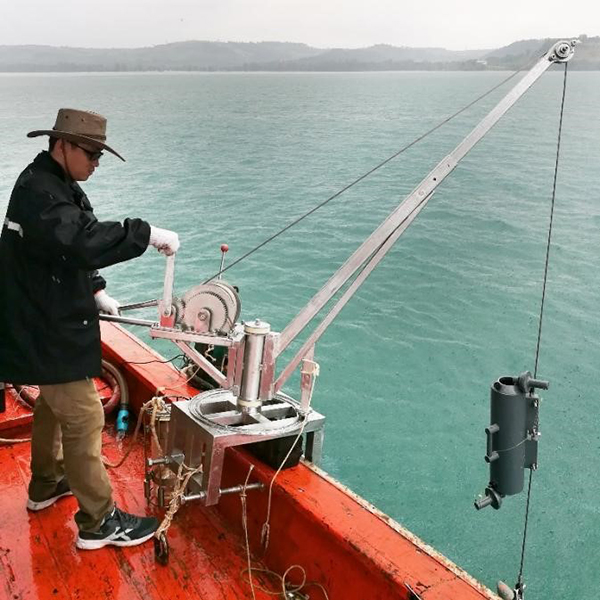
Portable Manual Winch for Marine and Field Equipment Deployment,
manual winch, manual winch for sensor deployment, manual winch for underwater instruments, marine equipment deployment winch, Marine Manual Winch,portable manual winch for marine applications, Portable Manual Winch, portable winch, portable winch for environmental sampling,
Technical Specifications
| Net Weight | 75 kg |
| Rated Working Load | 100 kg |
| Lifting Arm Extension Range | 1000 ~ 1500 mm |
| Supporting Wire Rope | φ6 mm, length: 100 m |
| Construction Material | 316 Stainless Steel |
| Lifting Arm Rotation Range | 360° |
Key Features
The lifting arm supports full 360° rotation. The unit adopts a portable fixed installation design and features neutral gear mode for free lowering of loads. Equipped with a band brake system to regulate descending speed during free payout.
The main frame is constructed from corrosion-resistant 316 stainless steel, paired with 316 stainless steel non-rotating wire rope. Built-in cable counter enables real-time measurement and recording of deployed cable length.
Portable Manual Winch for Marine and Field Equipment Deployment
Marine and environmental monitoring often requires equipment to be deployed in locations where electrical power is limited or unavailable. Underwater sensors, water samplers, CTD instruments, and other monitoring equipment may need to be lowered and retrieved safely from vessels, piers, platforms, or field stations.
A Portable Manual Winch provides a practical solution for these applications. By using manual operation rather than an electric motor, it can be transported easily, installed quickly, and operated in remote field environments.
FrankStar’s portable manual winch is designed for applications where mobility, simple operation, and controlled equipment deployment are important.
What Is a Portable Manual Winch?
A portable manual winch is a mechanically operated lifting and lowering device that uses a hand-operated mechanism to wind and unwind a wire rope or cable.
Unlike electric winches, a manual winch does not require an external power supply. This makes it particularly suitable for field operations, temporary monitoring stations, small research vessels, and other applications where portability is important.
Depending on the configuration, a portable manual winch can be used to:
Lower underwater sensors
Retrieve oceanographic instruments
Deploy water-quality monitoring equipment
Position sampling equipment at different depths
Lift lightweight marine equipment
Support temporary environmental monitoring operations
How Does a Manual Winch Work?
The operating principle is straightforward.
The wire rope is wound around a drum or reel. When the operator turns the manual handle, mechanical gearing transfers the applied force to the drum, allowing the cable to be extended or retrieved in a controlled manner.
During equipment deployment, the operator gradually releases the cable to lower the instrument. During retrieval, the handle is turned in the opposite direction to wind the cable back onto the drum.
This simple mechanical design eliminates the need for batteries, electrical connections, or a motor-driven control system.
Key Features of a Portable Manual Winch
1. Portable Design
A compact manual winch can be transported between different monitoring locations without requiring permanent installation.
This is particularly useful for:
Research vessels
Small boats
Temporary monitoring stations
Field survey teams
Environmental sampling projects
2. No External Power Required
One of the main advantages of a manual winch is its independence from electrical power.
Operators can use the equipment in remote locations where access to AC power, generators, or batteries may be limited.
3. Controlled Deployment
Manual operation allows the operator to control the speed of cable release and retrieval according to field conditions.
This can be useful when deploying sensitive instruments such as:
CTD profilers
Water-quality sensors
Temperature sensors
Conductivity sensors
Turbidity sensors
Water samplers
4. Simple Mechanical Operation
With fewer electrical components than an electric winch, a manual winch can provide a straightforward solution for routine deployment and retrieval operations.
Its mechanical operating principle also makes it convenient for field teams that need equipment that is easy to understand and operate.
5. Flexible Field Applications
A portable manual winch can be adapted to different monitoring environments depending on the mounting configuration, cable length, and working load requirements.
This makes it suitable for both short-term surveys and recurring environmental monitoring activities.
Applications of Portable Manual Winches
Marine and Oceanographic Research
Portable manual winches can be used for deploying oceanographic instruments from small vessels, docks, or temporary platforms.
Typical applications include:
CTD deployment
Water-quality profiling
Temperature and conductivity measurements
Marine sampling
Underwater sensor retrieval
Environmental Monitoring
Environmental monitoring teams frequently need to deploy sensors at specific depths.
A portable manual winch can support the controlled deployment and recovery of instruments used for:
Water-quality monitoring
River monitoring
Lake surveys
Coastal monitoring
Reservoir investigations
Field Water Sampling
For field sampling operations, equipment may need to be lowered to predetermined depths before collecting water samples.
A manual winch provides a simple mechanical method for controlling sampling equipment without relying on an electrical power source.
Small Research Vessels
Not every research vessel requires a large motorized winch.
For lightweight instruments and routine surveys, a portable marine manual winch can provide a more compact deployment solution while reducing system complexity.
Temporary Monitoring Stations
Portable equipment is especially useful for projects where the monitoring system is installed temporarily.
After the survey is completed, the winch can be removed, transported, and reused at another location.
or applications where portability, simplicity, and power independence are priorities, a manual winch can be a practical choice.
For heavier equipment or frequent automated deployment, an electric winch may be more appropriate.
What Should You Consider When Selecting a Portable Manual Winch?
Before selecting a manual winch for marine or environmental applications, several technical factors should be considered.
Working Load
The winch should be matched to the total suspended load, including the instrument, cable, connectors, and other underwater accessories.
Cable Length
The required cable length depends on the maximum deployment depth and the operating environment.
Cable Type
For marine and underwater applications, cable material and corrosion resistance are important considerations.
Mounting Method
The winch should be compatible with the vessel, platform, frame, or temporary mounting structure where it will be used.
Deployment Depth
Projects involving deeper measurements require sufficient cable capacity and an appropriate mechanical configuration.
Operating Environment
Saltwater, humidity, mud, and other harsh environmental conditions can affect equipment performance. Materials and protective finishes should therefore be selected according to the intended operating environment.