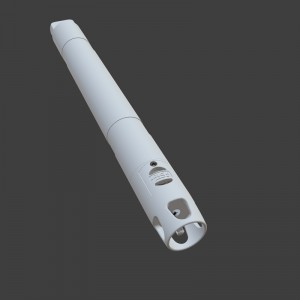
Self-Recording Pressure and Temperature Observation Tide Logger | Tide Monitoring

Self-Recording Pressure and Temperature Observation Tide Logger | Tide Monitoring,
,
Feature
Small size, light weight
2.8 million sets of measurements
Configurable sampling period
USB Data Download
Pressure calibration before water entry
Technical Parameter
Housing material: POM
Housing pressure: 350m
Power: 3.6V or 3.9V disposable lithium battery
Communication mode: USB
Storage space: 32M or 2.8 million sets of measurements
Sampling frequency: 1Hz/2Hz/4Hz
Sampling period: 1s-24h.
Clock drift: 10s / year
Pressure range:20m、50m、100m、200m、300m
Pressure accuracy:0.05%FS
Pressure resolution:0.001%FS
Temperature range:-5-40℃
Temperature accuracy:0.01℃
Temperature resolution:0.001℃
Contact us for a brochure!
Tidal observations are essential for understanding changes in sea level, coastal hydrodynamics, and marine environmental conditions. Accurate water-level records support oceanographic research, coastal engineering, port operations, estuary studies, and long-term environmental monitoring.
The FrankStar Self-Recording Pressure and Temperature Observation Tide Logger is designed to record pressure and temperature data for marine and hydrological observation. By collecting time-series measurements, the instrument can support the analysis of tidal variations and changing underwater conditions.
Pressure-based tide monitoring is particularly useful when direct visual observation of water level is impractical or when measurements are required at submerged locations.
With recorded pressure and temperature data, researchers can build datasets for tidal analysis, water-level variation studies, and environmental assessment.
What Is a Self-Recording Tide Logger?
A self-recording tide logger is an instrument designed to collect and store measurement data over a specified deployment period.
Unlike manual observations, which require personnel to record water levels at individual times, a data logger can collect measurements automatically according to its configured recording interval.
The FrankStar pressure and temperature tide logger is designed to record two important parameters:
Pressure: Provides information that can be used for pressure-based water-level and tidal analysis.
Temperature: Records temperature changes in the surrounding measurement environment and can support data interpretation.
The resulting time-series dataset can help users investigate tidal cycles, water-level fluctuations, and changes in underwater environmental conditions.
How Does a Pressure-Based Tide Logger Work?
A pressure-based tide logger uses pressure measurements to estimate changes in the height of the water column above the sensor.
A typical monitoring workflow includes the following steps.
Step 1: Install the Logger
The instrument is installed at a suitable underwater observation location, according to the deployment requirements.
Step 2: Measure Pressure and Temperature
The logger records pressure and temperature at configured intervals.
Step 3: Store Measurement Data
The collected readings are saved by the instrument for subsequent retrieval and analysis. The available recording and communication options depend on the specific configuration.
Step 4: Process Pressure Data
Pressure measurements are processed to estimate water-level changes. Depending on the deployment method, atmospheric pressure, water density, sensor elevation, and other relevant factors may need to be considered.
Step 5: Analyze Tidal Variations
The processed time series can be used to examine tidal cycles, water-level trends, and short-term fluctuations.
This workflow provides a practical approach to collecting tidal observations at locations where continuous manual monitoring is difficult.
What Can a Tide Logger Measure?
1. Pressure
Pressure is the primary measurement used for pressure-based tide observation.
As the height of the water column above a submerged sensor changes, the hydrostatic pressure changes accordingly. These variations can be processed to estimate changes in water level.
Pressure records can support:
Tidal variation analysis
Water-level fluctuation monitoring
Coastal hydrodynamic research
Estuary observation
Long-term sea-level data collection
For accurate water-level estimation, the pressure reference and deployment conditions must be considered.
2. Temperature
Water temperature is an important environmental parameter in marine and hydrological studies.
Temperature records can help researchers understand environmental changes during a deployment and support the interpretation of pressure measurements where temperature-related sensor effects are relevant.
Temperature data may also be useful in broader studies of coastal and underwater conditions.
3. Time-Series Data
Repeated measurements create a time series showing how pressure and temperature change throughout the deployment.
Time-series records can help users identify:
Tidal cycles
Daily and periodic fluctuations
Changes associated with weather events
Longer-term water-level patterns
Variations in underwater temperature
The usefulness of the data depends on the selected sampling interval, deployment duration, sensor configuration, and data-processing method.
Key Features of the Self-Recording Tide Logger
Automatic Data Recording
Automatic recording reduces the need for continuous manual observation and helps produce consistent datasets over the deployment period.
Combined Pressure and Temperature Observation
Recording both parameters provides complementary information for tidal analysis and environmental monitoring.
Suitable for Submerged Observation
Pressure-based measurement is well suited to applications where the sensor can be installed underwater at a known location.
Support for Time-Series Analysis
Recorded data can be used to examine tidal variations and changes in water-level conditions over time.
Flexible Monitoring Applications
The logger can be considered for coastal, estuarine, harbor, and other marine or hydrological monitoring projects, subject to the instrument’s specifications and deployment requirements.
Applications of a Pressure and Temperature Tide Logger
Coastal Tide Monitoring
Coastal water levels change in response to tides, atmospheric conditions, waves, and other environmental factors.
A pressure-based tide logger can support coastal observation projects by collecting pressure records for water-level analysis.
Harbor and Port Monitoring
Water-level information is important for harbor operations, marine engineering, and port-related environmental studies.
Tide logger data can contribute to the assessment of tidal variations and local water-level behavior.
Estuary Research
Estuaries are influenced by both marine tides and freshwater inflows. Pressure records can help researchers investigate water-level changes and tidal propagation within these environments.
Oceanographic Research
Time-series pressure and temperature data can complement observations from other oceanographic instruments and support studies of changing marine conditions.
Hydrological Monitoring
Depending on the installation and measurement requirements, pressure-based logging can also be considered for suitable water-level observation applications in channels, rivers, and other aquatic environments.
Coastal Engineering
Tidal and water-level data can support engineering assessments, site investigations, and the evaluation of local hydrodynamic conditions.