Drifting Profiling Data Buoy – Autonomous Ocean Water-Column Profiling System

Drifting Profiling Data Buoy – Autonomous Ocean Water-Column Profiling System,
autonomous ocean profiling buoy, autonomous water column monitoring system, drifting buoy for water column profiling, drifting ocean observation system, drifting profiling data buoy for ocean monitoring, multi-depth marine monitoring buoy, ocean profiling data buoy,
Sensors to assemble/ Element to monitor
| Oceanographic Data | Environmental Data | Additional Parameters |
| Currents | Water temperature | Acoustic profile |
| Salinity | Underwater noise | |
| Hydrocarbon | ||
| Note | ||
| More sensors can be added on Drifting Profiling Data Buoy (FS-DPDB) based on actual needs | ||
Technical Specifications
| Drifting Profiling Data Buoy | ||
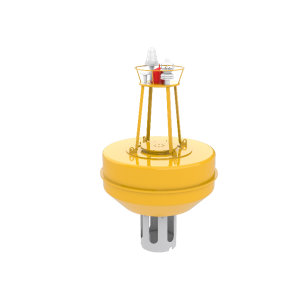
| Physical Specification | Model No. | FS-DPDB |
| Dimension | Φ936 mm (Hemisphere: 800 mm) | |
| H: 724 mm | ||
| Weight | 68kg | |
| Materials | Hull: Polyethylene (PE) | |
| Colour | Default orange, customizable | |
| Power Supply Range |
Batteries | Lithium battery pack |
| Battery capacity | 340 Ah | |
| Data Management | Data acquisition | Default 60 min, customizable |
| Battery life | 12 months | |
| Communication | Satellite | |
| Storage | Local SD card, 32G |
The ocean is a highly dynamic environment in which temperature, salinity, pressure, currents, and other physical and chemical parameters can change significantly with depth.
Surface observations alone cannot provide a complete understanding of the marine environment. For oceanographic research and environmental monitoring, scientists often need measurements from different depths throughout the water column.
A Drifting Profiling Data Buoy combines the mobility of an ocean drifter with the ability to collect measurements at different depths.
The FrankStar Drifting Profiling Data Buoy is designed for autonomous marine observation and water-column profiling. Instead of collecting data at only one fixed depth, the system can support repeated observations through different layers of the water column while drifting with the surrounding marine environment.
This provides a flexible solution for collecting spatially and vertically distributed oceanographic data.
What Is a Drifting Profiling Data Buoy?
A Drifting Profiling Data Buoy is an autonomous ocean observation platform designed to move with ocean currents while collecting environmental measurements at different depths.
A conventional drifting buoy generally focuses on observations near the surface.
A profiling buoy goes further by collecting measurements throughout the water column.
The combination can provide:
Horizontal Movement + Vertical Profiling + Environmental Observation
This makes a drifting profiling buoy particularly useful for studying changing ocean conditions across both space and depth.
Depending on the sensor configuration, a profiling data buoy may be used to observe parameters such as:
Water temperature
Salinity
Pressure
Conductivity
Dissolved oxygen
Other water-quality parameters
Ocean current characteristics
The exact parameters depend on the installed sensor package.
How Does a Drifting Profiling Data Buoy Work?
The operating concept can be summarized as:
Deployment → Drifting → Vertical Profiling → Data Collection → Data Storage/Transmission → Recovery or Continued Observation
After deployment, the buoy moves according to the surrounding ocean conditions.
At selected intervals, the profiling mechanism moves the sensor package through the water column or collects observations at predefined depths.
The sensors record environmental parameters during the profiling process.
The data can then be:
Stored onboard
Transmitted remotely
Associated with geographic position
Processed for scientific analysis
Repeated profiling cycles create a time series of vertical ocean observations along the buoy’s drifting trajectory.
Why Is Water-Column Profiling Important?
Ocean conditions are not uniform from the surface to the deeper water layers.
Temperature, salinity, pressure, dissolved oxygen, and other parameters can vary significantly with depth.
For example, oceanographers may need to identify:
Temperature gradients
Salinity gradients
Water-mass boundaries
Thermocline characteristics
Halocline characteristics
Vertical oxygen distribution
Changes in water-column structure
A single surface measurement cannot capture these vertical variations.
Profiling measurements provide a much more complete representation of the marine environment.
Key Applications of Drifting Profiling Data Buoys
1. Oceanographic Research
Water-column profiling is fundamental to oceanographic research.
A drifting profiling buoy can provide repeated observations across different locations, supporting studies of:
Ocean circulation
Water-mass movement
Temperature structure
Salinity distribution
Vertical ocean processes
2. Temperature and Salinity Profiling
Temperature and salinity are among the most important physical parameters in oceanography.
Their vertical distribution can be used to understand:
Water-mass characteristics
Ocean stratification
Mixing processes
Thermohaline circulation
Seasonal changes
A drifting profiling buoy can collect these measurements while moving through different marine environments.
3. Ocean Current Studies
Ocean currents transport heat, salt, nutrients, and other materials across large distances.
A drifting platform naturally follows the movement of the surrounding water, making trajectory information valuable for studying ocean circulation.
When combined with vertical profiling, researchers can examine both:
Where the water is moving + How the water column changes with depth
4. Marine Environmental Monitoring
The system can support marine environmental studies requiring measurements at multiple depths.
Potential applications include:
Marine pollution research
Environmental baseline surveys
Water-quality studies
Ecosystem research
Coastal and offshore environmental assessment
Additional sensors can be considered when specific water-quality parameters are required.
5. Climate and Ocean Observation
Long-term ocean observations are important for understanding changes in the marine environment.
Temperature and salinity profiles can contribute to research involving:
Ocean warming
Ocean stratification
Climate variability
Ocean circulation
Air-sea interaction
Drifting platforms can provide observations across broader geographic areas than fixed stations alone.
What Parameters Can a Profiling Data Buoy Measure?
The sensor package should be selected according to the scientific objectives of the project.
Water Temperature
Temperature measurements at different depths can reveal the thermal structure of the water column.
Temperature profiles can be used to investigate:
Thermoclines
Seasonal changes
Water-mass characteristics
Ocean mixing
Salinity
Salinity is another fundamental oceanographic parameter.
Vertical salinity profiles can help identify:
Water masses
Freshwater influence
Stratification
Mixing processes
Ocean circulation characteristics
Pressure and Depth
Pressure measurements can be used to determine the sensor’s position within the water column and support depth-related observations.
Depth information is essential for creating vertical profiles of other measured parameters.
Dissolved Oxygen
When equipped with an appropriate dissolved oxygen sensor, the profiling buoy can measure oxygen concentrations at different depths.
This can support:
Marine ecosystem research
Water-quality studies
Oxygen distribution analysis
Environmental assessment