
Marine environmental elements consist of marine meteorology, marine hydrology, marine geology and geophysics, marine physics, marine chemistry, marine biology, etc. They include multi-dimensional elements such as the sea-air interface and the lower atmosphere (such as clouds, rain, fog, air pressure, temperature, etc.), the sea surface (such as wind, waves, ice, storm surges, salt spray, solar radiation, temperature, salinity, tides, etc.), underwater (such as internal waves, circulation, thermoclines, sound channels, density, conductivity, depth, etc.) and the seabed (such as geology, geomorphology, magnetic field, gravity field, etc.).
Classification of Marine Environmental Sensing Equipment
Marine environment perception equipment is designed to obtain marine environment information, which is what we commonly refer to as marine observation, investigation, monitoring, and mapping equipment. It includes various types of sensors, collectors, processors, and the various fixed and mobile space-based, air-based, shore-based, and sea-based (surface and underwater) observation platforms they are carried on.
There are a wide variety of marine environment perception devices. Classified by environmental elements, they can be divided into temperature, salinity, depth, waves, currents, tides, wind, sound, and magnetic field, etc. Classified by sensors, they can be divided into acoustic, optical, electrical, thermal, and magnetic, etc. Classified by structural principles, they can be divided into acoustic instruments, optical instruments, electronic instruments, mechanical instruments, and remote sensing and telemetry instruments, etc. Classified by different carriers, they can be divided into shipborne instruments, submersible instruments, buoy instruments, shore station instruments, aircraft and satellite instruments, etc. Classified by the measured items, they can be divided into temperature measurement instruments, salinity measurement instruments, wave measurement instruments, current measurement instruments, nutrient salt instruments, gravity and magnetic force instruments, bottom sediment detection instruments, plankton and benthic organisms’ instruments, etc.
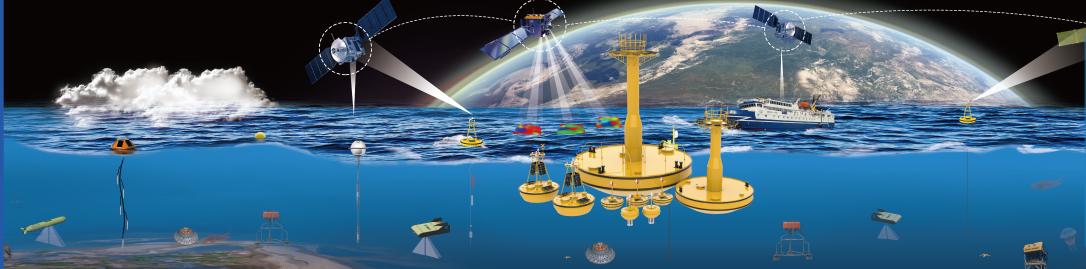
Marine environmental perception equipment can be classified into four major categories, namely, marine physical property observation instruments, marine chemical property observation instruments, marine biological observation instruments, and marine geological and geophysical observation instruments. Among them, marine observation instruments for ships have the most varieties. According to their operation methods, they can be further divided into expendable, self-returning, suspended, and towed types. Expendable instruments are used by dropping their sensor parts into the sea, and the observed data are transmitted to the ship through wires or radio waves. The sensors are not retrieved after use. Self-returning instruments sink into the sea during observation, and after completing the measurement or sampling task, they remove the ballast and return to the sea surface by their own buoyancy. Suspended instruments are sent into the sea from the ship’s side by the ship’s winch boom and are used for observation when the ship is anchored or drifting. Towed instruments are placed into the sea from the stern of the ship and towed behind the ship for underway observation.
The equipment for ocean observation, investigation, monitoring and mapping share many commn features in terms of instrument types, measurement elements, operation methods, data processing and application results. However, their respective application purposes and requirements for the results are different, so it is often difficult to make specific classifications. For example, an ocean survey vessel can serve as both an operation platform for ocean investigation and an operation platform for ocean monitoring and mapping; another example is the Acoustic Doppler Current Profiler (ADCP), which is an observation payload for both ocean investigation and ocean monitoring, and when used in the planning of ocean terminal construction projects, it becomes an observation payload for ocean mapping.
Ocean sensing equipment includes various ocean platforms such as satellites for remote sensing, unmanned aircraft, wave gliders, underwater gliders, autonomous underwater vehicles (AUVs), remotely controlled unmanned submersibles, surface unmanned boats, seabed-based systems, ocean survey ships, ocean buoys, ocean real-time observation networks, as well as load or sensors such as acoustic Doppler current profilers (ADCP), multi-beam bathymeters, synthetic aperture sonar (SAS), temperature-salinity-depth instruments (CTD), ocean magnetometers, side-scan sonars, ocean gravimeters, single-channel seismic systems, seafloor heat flow meters, underwater acoustic positioning systems, sediment traps, three-dimensional sonar systems, water level meters, and underwater inertial navigation equipment.
Post time: Feb-11-2026